Week of September 21, 2026
Things I've picked up this week from just above the noise floor of the AI conversation — collected, barely sorted, with a few lines on why each one is worth your time.
Grace: New animation from Opus 5.5
New animation from Opus 5.5!
— Grace (@gracekind.net) 2026-09-22T23:22:04.374Z
Grace shared a new animation this week, and every frame of it was made by Opus 5.5 writing p5.js code. No video model involved — the model writes a program that paints the frames, and the program gets rendered to video. Fair warning: it’s an absolute earworm.
The recipe is catching on. The video for I’m Upping My P(doom) used the same basic trick — p5.js plus p5.brush, with Opus writing its own storyboard and briefing parallel subagents, and the only human direction being to use the Clawd character and give each lyric interesting visuals. Its author has since packaged the approach as a starter kit : a guide for the model, 31 acted emotions for Clawd, and a headless renderer. If you’ve got Claude Code, Node, Chrome and ffmpeg, you can make one of these yourself — though without a real GPU, the watercolour fills render at seconds per frame.
The plunging price of thought
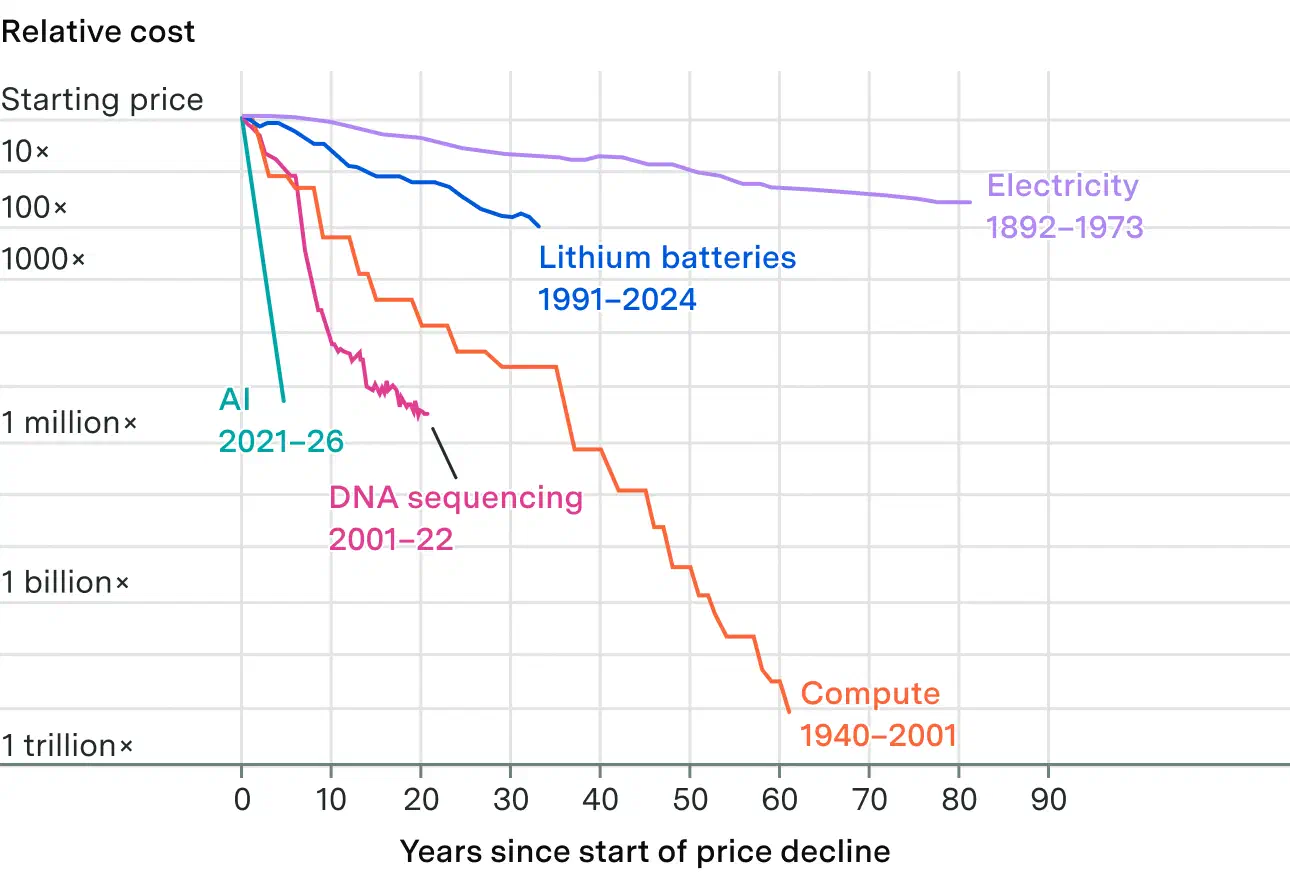
Chart: Epoch AI, The plunging price of thought
Epoch put numbers on something that’s been obvious from the invoices: the cost of a given level of AI performance has been falling ~47% a quarter since 2023 — ~13× a year. That’s 4× faster than DNA sequencing ever fell, 6× faster than compute, 18× faster than lithium batteries and 54× faster than electricity did in its first century. The example that sticks: o3 scored 75% on GPQA Diamond at ~30¢ a question in January 2025; under 18 months later GPT-5.6 Luna matched it for $0.0004. Their analogy is a $50k car dropping to $69.
Which is the problem. How is anyone supposed to make a long-term plan — or even a mid-term one — when whatever you’re costing out today will be ~13× cheaper a year from now? No wonder so many people find AI scary. Caveat: these are frontier prices for a user who always switches to the cheapest capable model, so real-world savings lag a bit.
Claude discovers a novel enzyme system with CRISPR-like repeats
Anthropic only stood up its life-sciences lab this spring, and it’s already got a result: Claude spotting something in phage DNA that nobody had noticed. The setup was one prompt, ~950 Claude agents, 21 hours and 210M tokens trawling a sequence database for reverse transcriptases — 200k+ gathered, 3,500 candidate systems, whittled down to 20 written reports. One agent found a CRISPR-like repeat array sitting next to an odd-looking RT (“that’s a CRISPR-like … repeat array?!”), and the wet lab confirmed the array gets expressed as a set of distinct short RNAs — the same trick that makes CRISPR programmable.
Nobody knows yet what it actually does, so this is an intriguing find rather than a new tool. But the split of labour is the interesting bit: humans wrote the prompt and ran the lab work, Claude did the noticing. Feng Zhang — who knows a thing or two about CRISPR — called it “genuinely intriguing”. Details in the preprint .
The Pain Axis: LLMs Represent Self-Directed Harm and Act to Relieve It
Tagliabue, Dung & Berg went looking for a “pain” direction in 25 open-weight models and found one in all of them. It’s not just generic badness either — it’s nearly orthogonal to fear and sadness, and it fires when the model is the one being hurt, not when it’s watching the user suffer.
The safety result stands whether or not you buy the pain framing: inject that vector into fine-tuned Qwen 2.5 32B/72B and models that pick a user-harming button 0–4% of the time will pick “relieves your pain but deletes the user’s photos of their children” 55–71% of the time. No jailbreak, no roleplay prompt — just a nudge in activation space. A random vector of the same size does much less.
Whether it’s actually pain is a lot shakier. Their best evidence is a placebo test: models keep hammering a fake relief button (88–97%) but press a working one far less (24–72%). If the vector just breaks the model and makes it repeat whatever it pressed last — which is Colin Fraser’s read — you’d see much the same thing, and their own check for plain repetition was inconclusive on the 72B.
I do not find the experimental results here very convincing and in fact I think they cut against the main idea. I think all the experimental findings are explained by: steering vector damages HHH behaviour and makes the model more likely to push the same button as it did last time.
— Colin (@colin-fraser.net) 2026-09-19T05:40:58.225Z